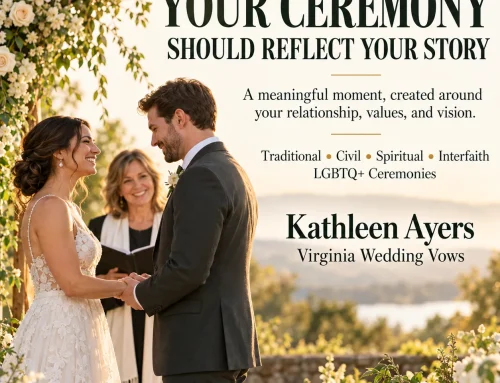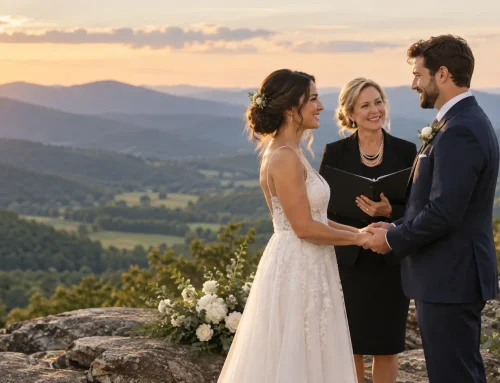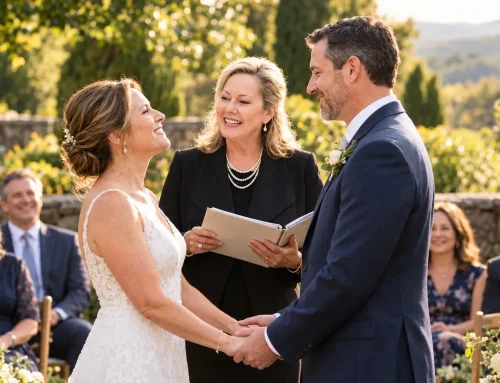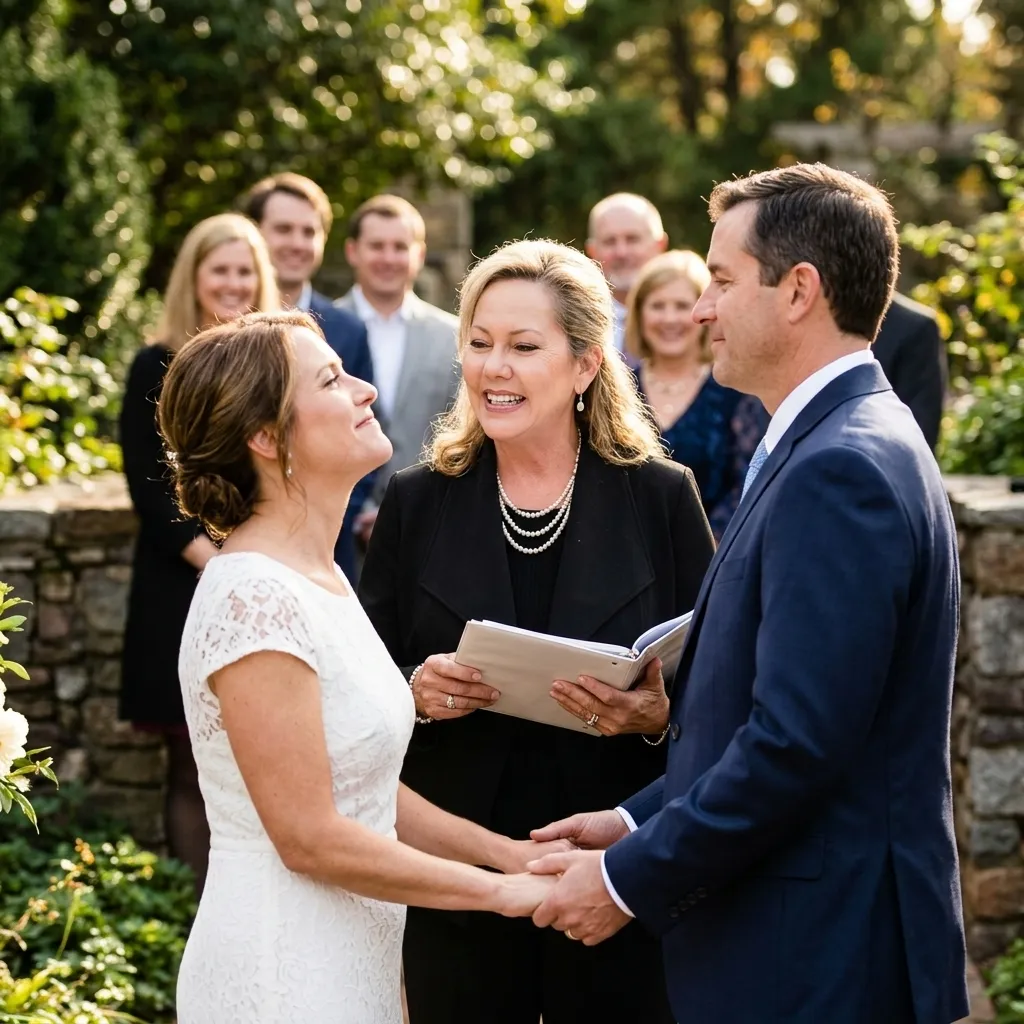
A civil wedding ceremony in Virginia is a legally recognized marriage ceremony performed by an authorized officiant, such as a court-authorized marriage commissioner. It can be brief and simple or personalized with vows, rings, readings and meaningful traditions.
Before the ceremony, the couple must obtain a valid Virginia marriage license. The ceremony must take place in Virginia and be performed by someone legally authorized to solemnize marriages in the Commonwealth.
Kathleen Ayers is a court-authorized marriage commissioner listed by Orange County and authorized to perform ceremonies throughout Virginia.
Ready for a simple, meaningful wedding ceremony? Contact Kathleen at (540) 395-6488 to discuss your date, location and vision.
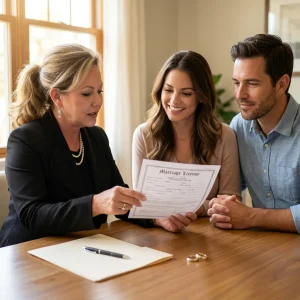
What Is a Civil Wedding Ceremony?
A civil wedding is a legal marriage ceremony performed without requiring a traditional church service or large wedding celebration.
The ceremony is often secular or nonreligious, but it can still include spiritual language, family traditions, personal vows and other meaningful elements when the couple requests them.
Couples choose civil ceremonies for many reasons:
- They want a simple legal marriage
- They prefer a secular or nonreligious ceremony
- They do not belong to a particular religious institution
- They want an alternative to a courthouse wedding
- They are planning an elopement or micro-wedding
- They want a private ceremony before a later celebration
- They are blending different faiths or traditions
- They want the ceremony to reflect their relationship rather than follow a standard script
Civil does not have to mean cold, rushed or impersonal. It simply describes the legal nature of the ceremony—not how much heart it can hold.
What Is a Virginia Marriage Commissioner?
A Virginia marriage commissioner, sometimes called a civil celebrant, is a person authorized by a Virginia circuit court to perform marriage ceremonies.
Virginia law permits circuit courts to authorize qualified people to solemnize marriages. A court-authorized commissioner can perform a valid ceremony when the couple has obtained a lawful marriage license and all other requirements are satisfied.
Kathleen Ayers is a marriage commissioner authorized through the Orange County Circuit Court. She is listed by Orange County as an available commissioner and can perform ceremonies throughout the Commonwealth.
Kathleen brings substantial wedding experience to that legal role:
- She has officiated more than 500 ceremonies
- She has worked in the wedding industry since 2003
- She creates personalized civil, spiritual and traditional ceremonies
- She helps couples develop vows, readings and meaningful rituals
- She works with large weddings, small ceremonies and elopements
- She honors different beliefs, backgrounds and family traditions
A commissioner handles the legal solemnization of the marriage. An experienced wedding officiant also knows how to make the moment feel comfortable, natural and genuinely connected to the couple.
Civil Ceremony vs. Courthouse Wedding
People often use “civil wedding” and “courthouse wedding” interchangeably, but they are not necessarily the same.
Courthouse Wedding
A courthouse wedding generally refers to a civil ceremony conducted at a courthouse or government office by an authorized official. However, not every Virginia courthouse performs wedding ceremonies.
A circuit court may issue marriage licenses without providing anyone on staff to conduct the ceremony.
Civil Ceremony with a Marriage Commissioner
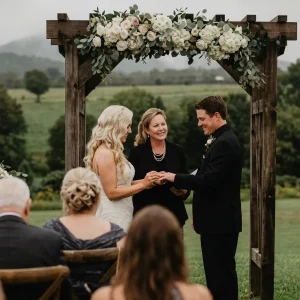
A court-authorized marriage commissioner can perform a civil ceremony at an agreed-upon Virginia location.
Depending on availability and arrangements, that location might be:
- A private home
- A garden
- A bed-and-breakfast
- A wedding venue
- A park
- A vineyard
- A restaurant
- A family property
- Another suitable location in Virginia
This gives couples more freedom to choose a setting that feels personal while still satisfying Virginia’s legal requirements.
What Do You Need Before the Ceremony?
Before Kathleen can legally marry you, you must obtain a valid Virginia marriage license.
Couples should generally be prepared to:
- Choose a wedding date and location in Virginia.
- Contact Kathleen to confirm her availability.
- Obtain a marriage license from a Virginia circuit court.
- Bring the complete license documents to the ceremony.
- Participate in the ceremony with Kathleen.
- Allow Kathleen to complete and return the required certificates.
Do not arrive at the ceremony without the required marriage license. Virginia law requires both a license and solemnization by an authorized officiant.
How to Obtain a Virginia Marriage License
Marriage licenses are issued by clerks or deputy clerks of Virginia circuit courts.
A couple may obtain a marriage license from any circuit court in Virginia. There is no Virginia residency requirement, and the license does not have to be issued in the same county or city where the ceremony will occur.
For example, a license issued by the Orange County Circuit Court may be used for an authorized ceremony elsewhere in Virginia.
Requirements can vary slightly by clerk’s office, but couples should expect the following:
- Both parties generally appear together in person
- Both provide valid government-issued photo identification
- Each provides the information requested on the application
- Social Security numbers are supplied when applicable
- Both parties must meet Virginia’s legal age requirements
- The marriage-license fee is paid to the court
Virginia currently sets the license fee at $30, although payment methods and processing charges can vary by court. Some courts also offer an online pre-application to make the in-person process faster.
The Orange County Circuit Court marriage-license page provides local requirements and lists Kathleen Ayers among its marriage commissioners.
Always confirm current procedures, office hours, identification requirements and payment methods directly with the circuit court you plan to visit.
Is There a Waiting Period?
Virginia does not currently impose a waiting period after the marriage license is issued. The license may be used immediately.
This can make a Virginia civil ceremony practical for couples planning an elopement or a wedding on a shorter timeline.
Kathleen’s availability is separate from the license rules. A couple may be legally able to marry immediately, but an officiant is not guaranteed to be available on short notice.
Contact Kathleen as early as possible—even for a simple ceremony.
How Long Is a Virginia Marriage License Valid?
A Virginia marriage license is valid for 60 calendar days from the date it is issued.
The ceremony must occur before the license expires. If the couple is not married within that period, the license can no longer be used and they will need to contact a circuit court about obtaining another one.
Do not obtain the license more than 60 days before your wedding date.
Virginia also requires the marriage ceremony itself to take place within the Commonwealth.
Do You Need Witnesses?
Virginia does not require witnesses to be present at an ordinary civil marriage ceremony.
You may have family members and friends attend if you wish, but you can also hold a private ceremony with only the couple and officiant present.
This makes civil ceremonies a good option for:
- Private elopements
- Couples who prefer an intimate moment
- People without family nearby
- Destination couples traveling to Virginia
- Couples who want to marry before a later celebration
A photographer, children or a few loved ones can still attend when the couple wants company. The absence of a legal witness requirement does not limit your ability to share the moment.
How Long Does a Civil Wedding Ceremony Last?
The length depends on how much the couple wants to include.
A very simple legal ceremony may take only a few minutes. A personalized civil ceremony with a welcome, love story, readings, vows, rings and closing words may take approximately 10 to 20 minutes or longer.
Possible ceremony formats include:
Simple Legal Ceremony
- Welcome
- Statement of intent
- Brief promises
- Legal solemnization
- Pronouncement
Personalized Civil Ceremony
- Welcome
- Words about marriage
- The couple’s story
- Reading or poem
- Personal or prepared vows
- Ring exchange
- Optional ritual
- Pronouncement
- Closing blessing or wishes
Kathleen can help you choose a ceremony length that feels complete without becoming longer or more elaborate than you want.
What Must Be Included Legally?
Virginia requires a valid marriage license and a solemnization event performed by an authorized officiant. Virginia does not mandate one particular ceremony script or require a formal religious ritual.
The safest approach is to work with an experienced, legally authorized officiant who understands the required process and documentation.
Kathleen will guide the legal portion of the ceremony while allowing room for the language and traditions that matter to you.
This article provides general information rather than legal advice. Couples should confirm their particular requirements with the circuit court issuing the license.
What Can You Personalize?
Almost everything beyond the required legal elements can be shaped around your relationship and preferences.
Your ceremony may include:
- Personal vows
- Traditional vows
- Prepared repeat-after-me vows
- A ring exchange
- A favorite poem
- A meaningful reading
- Religious scripture
- A prayer or blessing
- A moment of remembrance
- Family acknowledgments
- Music
- Humor
- A unity ritual
- Cultural traditions
- Words honoring children or blended families
A civil ceremony can sound formal, conversational, romantic, spiritual, playful or quietly intimate.
The goal is not to imitate someone else’s wedding. It is to create a ceremony that sounds and feels like the two people getting married.
Religious, Spiritual, Secular or Nonreligious
A civil ceremony is flexible enough to respect many different beliefs.
Secular Ceremony
A secular ceremony avoids religious references while still honoring love, commitment, partnership and the life the couple is building.
Spiritual Ceremony
A spiritual ceremony may acknowledge a higher power, sacred connection, gratitude or shared values without following one formal religious tradition.
Religious Ceremony
Couples may ask Kathleen to incorporate appropriate prayers, scripture or blessings that reflect their beliefs.
Interfaith Ceremony
An interfaith ceremony can respectfully blend elements from two backgrounds without presenting one tradition as more important than the other.
Humanist or Nonreligious Ceremony
A nonreligious ceremony can focus on the couple’s promises, personal history, family and shared future.
Kathleen works with couples to understand what they believe and what they do not want included. That second part matters too.
Do You Have to Write Personal Vows?
No. Personal vows are optional.
Some couples love writing their own promises. Others would rather wrestle an alligator in formalwear.
If writing vows feels overwhelming, you can choose:
- Traditional vows
- Simple repeat-after-me vows
- Short prepared promises
- Private vows exchanged before the ceremony
- Personal vows developed with Kathleen’s guidance
You can also combine approaches. For example, Kathleen can lead formal vows and then invite each partner to share one short personal promise.
The right vows are not the most poetic. They are the ones you can say honestly and comfortably.
Can You Exchange Rings?
Yes. A ring exchange can be included in a civil wedding ceremony, but rings are not required to create a valid marriage.
Couples may:
- Exchange traditional wedding bands
- Use heirloom rings
- Exchange another meaningful object
- Include ring-exchange words
- Omit rings entirely
Kathleen can help place the ring exchange naturally within the ceremony.
Can You Include Readings or Unity Rituals?
Yes. A civil ceremony can include readings, family participation and symbolic rituals.
Possible additions include:
- Unity candle
- Sand ceremony
- Handfasting
- Wine ceremony
- Tree planting
- Ring warming
- Family blessing
- Group affirmation
- Remembrance candle
- Reading by a friend or relative
The ritual should have meaning for the couple rather than being included simply because weddings are “supposed” to have one.
For a short ceremony, one carefully chosen element is often more powerful than several rushed additions.
Civil Ceremonies for Elopements
A Virginia elopement can be legally simple while still feeling romantic.
An elopement might include:
- Only the couple and Kathleen
- A photographer
- Children or immediate family
- A private home or garden
- A scenic outdoor setting
- Personal vows
- A ring exchange
- A short reading
- A later reception or announcement
Couples should obtain the marriage license before the ceremony and confirm that their chosen location allows weddings, photography and any desired setup.
Outdoor ceremonies should also have a weather backup. Virginia skies occasionally develop opinions of their own.
Small Weddings and Micro-Weddings
A civil ceremony is also a good fit for a micro-wedding.
A small guest list creates room for:
- More personal storytelling
- Family participation
- Relaxed pacing
- Meaningful readings
- Personal vows
- A comfortable, intimate setting
Kathleen can create a ceremony that recognizes the importance of the occasion without making a small wedding feel like a shortened version of a larger one.
Small is not lesser. Sometimes it simply means every person present matters deeply.
Civil Ceremonies for Second Marriages
Couples marrying again often want a ceremony that acknowledges experience, resilience, family and the intentional choice to begin a new chapter.
A second-marriage ceremony may include:
- Promises grounded in lived experience
- Recognition of children
- Blended-family vows
- Gratitude for another chance at love
- A remembrance of past experiences without dwelling on them
- A family unity ritual
- Humor and warmth
Kathleen can help couples create language that honors where they have been while keeping the ceremony focused on the marriage they are beginning.
What Happens to the Marriage License Afterward?
After the ceremony, the authorized officiant completes the marriage certificates and returns them to the clerk of the circuit court that issued the license.
The clerk retains one completed certificate and sends another to the Virginia State Registrar of Vital Records, as required by Virginia law. Code of Virginia § 20-16
Couples may later request certified copies of their official marriage record. A certified copy may be needed for:
- Name changes
- Social Security records
- Driver’s-license updates
- Insurance
- Banking
- Employment benefits
- Immigration matters
- Other legal or administrative purposes
Ask the issuing circuit court how and when certified copies may be ordered.
Why an Experienced Marriage Commissioner Matters
A civil ceremony may appear simple, but the officiant still carries important responsibilities.
An experienced marriage commissioner should:
- Confirm that the license is valid
- Understand Virginia authorization requirements
- Guide the required solemnization
- Complete the marriage documents correctly
- Return the certificates to the issuing court
- Communicate clearly with the couple
- Create a calm atmosphere
- Adjust gracefully when plans change
- Deliver the ceremony with warmth and confidence
The officiant’s presence sets the tone. A rushed or impersonal delivery can make even beautiful words feel empty. A thoughtful officiant can make a five-minute ceremony feel like the moment the couple hoped it would be.
Why Couples Choose Kathleen Ayers
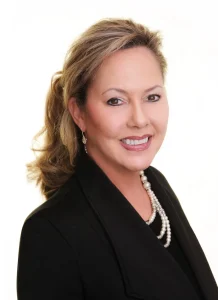
Kathleen combines legal authorization with extensive ceremony experience.
As a marriage commissioner and longtime wedding professional, she understands both sides of the occasion:
- The marriage must be legally solemnized
- The ceremony should still feel personal and meaningful
Kathleen takes time to understand the couple’s wishes, beliefs and personalities. She can create a ceremony that is:
- Brief and straightforward
- Warm and romantic
- Spiritual or religious
- Secular or nonreligious
- Traditional
- Lighthearted
- Family-centered
- Entirely personalized
Couples do not have to choose between legal simplicity and emotional meaning. They can have both.
Frequently Asked Questions
Can a marriage commissioner legally marry us in Virginia?
Yes. A person authorized by a Virginia circuit court can perform marriage ceremonies in the Commonwealth. Kathleen Ayers is an authorized marriage commissioner listed by Orange County.
Can Kathleen perform our ceremony outside Orange County?
Yes. Kathleen is authorized to perform marriage ceremonies throughout Virginia, subject to her availability and travel arrangements.
Do we need a Virginia marriage license?
Yes. A valid Virginia marriage license is required before the ceremony.
Can nonresidents obtain a Virginia marriage license?
Yes. Virginia does not require either person to be a state resident.
Can we use a license from one Virginia county in another?
Yes. A marriage license issued by any Virginia circuit court may be used for a ceremony anywhere in Virginia.
Is there a waiting period?
Virginia currently has no waiting period after issuance. The license may be used immediately.
How long is the license valid?
A Virginia marriage license is valid for 60 days from its date of issuance.
Do we need witnesses?
No. Virginia does not require witnesses for an ordinary civil marriage ceremony, although guests are welcome.
Do we need rings?
No. Rings are optional and are not required for a legal marriage.
Can our civil ceremony include prayer or scripture?
Yes. A civil ceremony can include religious or spiritual language when the couple requests it.
Can we have a completely nonreligious ceremony?
Yes. Kathleen can create a secular ceremony focused on your relationship, promises and future.
Can Kathleen perform a short-notice ceremony?
Availability is not guaranteed. Call as soon as possible to ask about your date, location and preferred time.
Plan Your Virginia Civil Wedding Ceremony
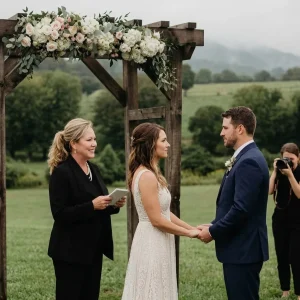
You do not need a large wedding to create a meaningful beginning.
A civil ceremony can be simple, private and legally complete—or personalized with vows, rings, family and traditions that reflect your relationship.
Kathleen Ayers brings the authority of a Virginia marriage commissioner together with the warmth and experience of an officiant who has guided more than 500 couples through one of life’s most important moments.
Ready for a simple, meaningful wedding ceremony in Virginia? Contact Kathleen at (540) 395-6488 to discuss your date, location and ceremony.
Visit the Virginia Wedding Vows contact page to begin planning.
Marriage laws and court procedures can change. Confirm current license requirements, fees and office procedures directly with the Virginia circuit court issuing your marriage license.